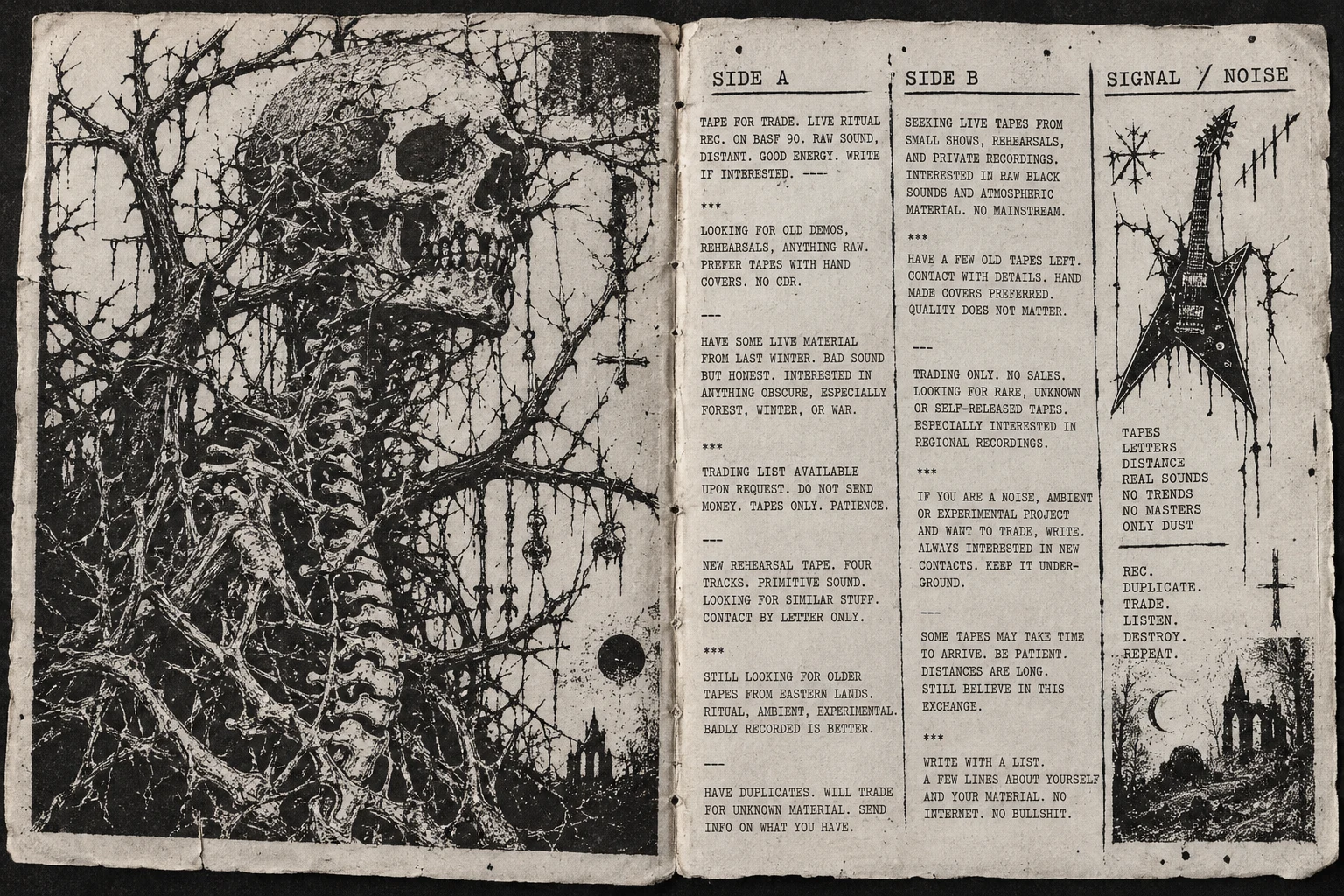
An original photocopied zine spread with anatomical ink artwork and dense tape-trading typography.
BASEMENT SIGNAL — PRINTED MATTER / ISSUE 01

Experiment · gothic zine

Basement Signal

An invented fanzine about tapes, four-tracks and photocopiers. Read it page by page, or as plain text. Then fold a mini-zine of your own.

Contents

Inside

Turn the pages with the buttons, the arrow keys, or the numbered squares. Prefer to scroll? Switch to the plain reading mode above.

Ed. note: the numbers are page numbers. Squares below the reader jump too.

01 · Words

What a zine is

Side A · Kit list

  • Typewriter or a pen
  • Glue stick, scissors
  • A friendly copy shop
  • Stamps for the post

Side B · Glossary

  • Run: copies printed
  • Masthead: the title block
  • Folio: the page number
  • Staple bind: pages, spine

A fanzine is a small, self-published magazine made by fans, for fans. The word dates from around 1940, in science-fiction fandom.

Punk zines of the late 1970s, Sniffin’ Glue (1976) among them, showed that you needed little more than a typewriter, a pen and access to a photocopier.

Ed. note: if it is made by hand and given away, it counts.

02 · Post

Tape trading

Fig. 1 · A letter, a stamp, a dubbed tape. Drawn for this page.

Side A · Trading rules

  • Label every tape
  • Write back within a month
  • Send a spare blank
  • Never sell a trade

Side B · Packing

  • Card sleeve for the case
  • Letter goes on top
  • Stamp, address, hope
  • Keep a ledger

Through the 1980s, fans in underground metal, punk and hardcore scenes traded cassette copies of demos by post. Dubbing a tape cost very little, and a letter slipped into the envelope often began a long correspondence.

Zines printed address lists, review columns and trade requests so these networks could find each other. A tape copied from a copy lost a little more of its high end each time.

Ed. note: a ledger saves arguments. Write down who owes whom.

03 · Machines

Four tracks, one cassette

1 2 3 4 BOUNCE
Fig. 2 · Three tracks bounced onto track four to free the others.

Side A · Gear list

  • Four-track cassette deck
  • One dynamic mic, one cable
  • Spare cassettes
  • Closed-back headphones

Side B · Glossary

  • Bounce: mix tracks to one
  • Punch-in: redo one bar
  • Hiss: the tape’s own noise
  • Pan: place left or right

TEAC introduced the Portastudio in 1979: a four-track recorder that used ordinary compact cassettes. A band could record guitars, bass and drums on separate tracks, then bounce several tracks onto one to free space for more.

Tape hiss, few tracks and no way to fix it later were limits, and the limits shaped the sound.

Ed. note: bounce only when you are sure. There is no undo.

04 · Sound

Clipping

CLEAN CLIPPED
Fig. 3 · The same signal, before and after the peaks run out of room.

Side A · Signal path

  • Guitar or bass
  • Pedal, if you have one
  • Amplifier
  • Microphone

Side B · Glossary

  • Gain: how hard you push
  • Headroom: room left
  • Harmonics: added overtones
  • Saturation: soft squash

Distortion happens when a signal is pushed past what a circuit or speaker can reproduce cleanly. The tops of the waveform flatten, or clip, and new harmonics appear.

Guitarists got it by overdriving valve amplifiers, then with pedals. Recorded to cassette, loud signals also squash softly in the tape itself, which is called tape saturation.

Ed. note: turn it down a notch and listen again before you decide.

05 · Layout

Cut and paste

HEADLINE CUT HERE
Fig. 4 · A paste-up before it goes to the copier.

Side A · Toolbox

  • Scissors, craft knife
  • Glue stick
  • Correction fluid
  • Ruler and pencil

Side B · Glossary

  • Gutter: space between
  • Bleed: ink to the edge
  • Leading: line gap
  • Crop mark: trim here

Before layout software, zine pages were assembled by hand. Typed columns and photographs were cut out and stuck down with glue, and headlines sometimes came from dry-transfer lettering sheets such as Letraset.

Mistakes were covered with correction fluid. The page was then photocopied, which flattened the layers into one sheet.

Ed. note: keep the glue off the glass of the copier.

06 · Print

Copying the copy

Original
3rd copy
6th copy
Fig. 5 · The words “Signal in” after zero, three and six simulated copies.

Side A · Settings

  • Lighter
  • Darker
  • Text mode
  • Photo mode

Side B · Glossary

  • Halftone: a dot pattern
  • Generation: copy number
  • Toner: the dry ink
  • Dropout: detail lost

A photocopier reads greys as patterns of black dots, called a halftone, and pushes everything toward black or white. Copy a copy and contrast climbs, fine detail fills in and specks multiply.

That loss between generations is where the rough look comes from. The samples below show one line of type after more copies. The effect is simulated here.

Ed. note: the sixth copy is rarely the best copy.

07 · Archives

Where zines end up

Fig. 6 · Stapled spines, saved.

Side A · Keep it

  • Acid-free sleeves
  • Cool, dry shelf
  • Number each issue
  • Write the date inside

Side B · Share it

  • Ask before you scan
  • Credit the makers
  • Donate a spare copy
  • Lend, then get it back

Libraries and archives now collect zines. The Library of Congress, for one, has a page on fanzine culture in its comic-art exhibition.

Print runs were tiny and paper is fragile, so many issues survive in only a few copies.

Ed. note: one copy in a drawer is better than none anywhere.

Library of Congress: fanzine culture ↗

Colophon

Pass it on

Side A · Credits

  • Words: invented
  • Drawings: procedural
  • Type: system fonts
  • Paper: pixels

Side B · Specs

  • Run: unlimited
  • Staples: two
  • Pages: ten
  • Price: free

Basement Signal is an invented zine made for this page. Its words and drawings are original, nothing is quoted from a real publication, and no band or release is named.

The notes are general history written from memory of common sources. Verify before you repeat them. Below the reader you can build your own eight-panel mini-zine from a single sheet.

Ed. note: fold the mini-zine below, then give it to somebody.

Fold your own mini-zine ↓

Make one

Fold your own

One sheet of paper makes an eight-panel mini-zine. Panel 1 is your cover, 8 is the back, and the six between are yours. Pick clippings from this issue, put them in order, then print and fold.

The mini-zine maker needs JavaScript. The notes above are all readable without it.